Why does night precede day in Surah At-Takwir? God, the All-Wise, conveys His messages to us through the Holy Quran. He always sends us proof that He is the Creator of the entire universe and that the Holy Quran is His revelation to all of humanity. In Surah At-Takwir, God mentions night before day because before He created the sun in our galaxy (the Milky Way), darkness covered the entire earth. This darkness is what we call night.
Then God created the sun to rise on the earth, and that was the first morning on Earth. This means that night preceded morning in creation.
The mention of this fact in Surah At-Takwir is proof that God is the Creator and that the Quran is His word, which He sent to people as the final revelation.
Surah At-Takwir in the Holy Quran describes a scene from the Day of Judgment: the folding of the sun, as God Almighty says:
“The sun will be folded up”
At-Takwir means folding or gathering in Arabic. The full meaning of this verse:
“When the sun is folded up” means: “When the sun is folded up in darkness.”
(It is mentioned that the sun will be folded up and its light will be extinguished, just as something is folded upon itself (like folding clothes), so everything will be dark after the sun is folded up.)
God points to this fact as an important sign indicating the occurrence of the Day of Judgment, among other signs. The importance of the sun stems from its great impact, not only on humans but on all creatures on Earth. Without it, there would be no life. So what will people do when the sun is obscured?
Read Surah At-Takwir online

سورة التكوير قراءة اون لاين
The Meaning of Surah At-Takwir
Every surah in the Holy Quran carries a profound message conveyed to the disbelievers of Mecca, and to those who came after them in later ages until the end of time.
The people of Mecca denied that the Prophet Muhammad (peace and blessings be upon him) was a true prophet sent by God. They called him insane, did not take his words seriously, mocked him, and sometimes even described him as a misguided messenger of Satan.
Through Surah At-Takwir, God sent a warning to the enemies of the Prophet Muhammad (peace and blessings be upon him) about the Day of Judgment and its immense horror, so that they might come to their senses, believe in the Prophet Muhammad (peace and blessings be upon him) as the true Messenger of God, and take his message seriously.
The first message, found at the beginning of Surah At-Takwir, outlines many signs of the Hereafter, foreshadowing the great changes that will occur at the end of the world and the formation of the new world: the Day of Judgment and what follows.
The second message, found in the middle of Surah At-Takwir, demonstrates the truthfulness and legitimacy of the Quranic revelation.
It also clarifies that the Holy Quran was revealed through the angel Gabriel, and that it had a profound enlightening effect on humankind, guiding them and elevating their status among all of God’s creation in this world and the hereafter. Surah At-Takwir then continues its defense of the Prophet Muhammad (peace be upon him) against accusations of madness or misguidance.
In conclusion, Surah At-Takwir indicates that the Holy Quran is the word of God to humanity, reminding them of righteousness, good character, and faith in God, the Lord of all creation.
Surah At-Takwir by Mishari
Where was Surah At-Takwir revealed?
Muslim scholars used to study the structure of each surah to determine the place of revelation. There were two places where revelation was sent down from God through the angel Gabriel to the Prophet Muhammad (peace be upon him): Mecca and Medina.
Scholars have narrated that the structure of Surah At-Takwir, its compositional characteristics, and its meanings indicate that it was revealed in Mecca.
Immerse yourself in the beauty of reciting the Holy Quran! Discover the power of recitation, deepen your connection, and enrich your soul.
Join us to explore authentic reading methods, refine your recitation skills, and experience the profound impact of the verses of the Holy Quran. Begin your journey with us today, and let the beauty of recitation fill your heart and mind!
When was Surah At-Takwir revealed?
We previously knew that surahs were classified according to both the place and time of their revelation.
Thanks to the diligent efforts of Muslim scholars in studying the sources left to us by the Companions of the Prophet Muhammad, they were able to determine the time of the revelation of Surah At-Takwir. According to numerous studies, Surah At-Takwir was revealed between approximately 610 and 616 CE, during the early days of the Prophet’s mission in Mecca.
Why was Surah At-Takwir revealed?
Every surah in the Quran carries a message to convey. In the early days of the Prophethood, many surahs were introduced to remind the people of Mecca, and indeed all of humanity, of the end times, so that they might correct their misguided paths and return to God.
Surah At-Takwir addresses three main points:
● First: An introduction to a scene from the end times.
● Second: The Quran was delivered to the Prophet Muhammad (peace be upon him) by the angel Gabriel, and the fact that the Prophet Muhammad was not insane or deluded by Satan.
● Third: The Quran is God’s message to all of humanity, including the people of Mecca.
Is Surah At-Takwir Meccan or Medinan?
Yes, Surah At-Takwir is Meccan.
Surah At-Takwir, which means “The sun will be enveloped in darkness,” is the eighty-first surah of the Holy Quran, consisting of 29 verses and 104 words.
Surah At-Takwir Tafseer
Ibn Kathir was one of the greatest Quranic commentators, and he presented its meanings in the simplest way possible to make it easier for Muslims to understand.
In this section, we will present his interpretation of Surah At-Takwir verse by verse.
In the name of Allah, the Most Gracious, the Most Merciful.
When the sun is folded up (1)
(1) When the sun is folded up.
Meaning: It will darken. Ibn Abbas said: It will go away. Qatadah said: Its light will go away.
And when the stars are scattered (2)
And when the stars are scattered. (Meaning: When they are scattered)
And when the mountains are set in motion (3)
(3) And when the mountains are set in motion. On that Day, they will not remain in their places and will perish. Then the earth will be left flat and barren.
And when the pregnant camels are neglected (4)
(4) And when the clouds are blown away. That is, their owners neglected them, so people were preoccupied with other things and neglected their care or use.
And when the wild beasts are gathered together (5)
(5) And when the wild beasts are gathered together. Meaning: The wild beasts will be gathered together. 6
And when the seas are set ablaze.
(6) And when the seas are set ablaze. (Meaning: When the seas become a blazing fire.)
And when the souls are paired.
(7) And when the souls are paired. (Meaning: Souls with the same characteristics will be joined together, i.e., with soulmates.)
And when the infant buried alive is questioned.
(8) And when the infant buried alive is questioned. (Meaning: The infant girl whom her father buried alive is questioned.)
For what sin was she killed? (9)
For what sin was she killed? He said: For what sin was she killed? The disbelievers of Quraysh used to bury their nursing daughters alive because they believed at that time that being a female was a great disgrace.
And when the scrolls are unfolded (10)
(10) Then when the scrolls are spread out (10) and every person is given his scroll in his right hand or his left hand, one after another.
And when the sky is stripped away (11)
(11) And when the sky is stripped away. (Meaning: The sky is withdrawn.)
And when Hell is kindled (12)
(12) And when the fire is kindled. (Meaning: Hell will be heated until it is intensely hot.)
And when Paradise is brought near (13)
(13) And when it is brought near. That is, when Paradise draws near to its inhabitants or the believers, and they see it with their own eyes.
Then every soul will know what it has brought forth (14)
(14) Then every soul will know what it has brought forth. “On the Day when these things occur, every soul will know what it has done, and it will be brought forth for it.”
So I swear by the retreating stars (15)
(15) So I swear by the setting stars, that is, God swears by the stars that set during the day.
The planets that move and disappear (16)
(16) That move and set. And God swears by the paths of these stars and that they sweep across the sky at night.
And by the night when it darkens (17)
(17) And by the night when it draws near. There are two interpretations of this: One is: “When it envelops the people.”
And by the morning when it breathes (18)
(18) And by the dawn when it breathes. “Meaning: ‘When it rises’ also: ‘When it shines forth and advances.’”
Indeed, it is the word of a noble messenger (19)
(19) Indeed, it is the word of a noble messenger (i.e.,
This Qur’an is conveyed by a noble messenger) meaning: It is a noble messenger, a noble angel, of good character and insight, referring to the angel Gabriel.
(20) Possessing power, secure in the presence of the Lord of the Throne.
He is secure in the presence of the Lord of the Throne. “That is, he (Gabriel) has a high and exalted position with God.”
Obeyed there, and trustworthy. 21
(21) Obeyed there (in the heavens) and trustworthy.
Meaning, in the heavens. He is not one of the lower angels, but one of the highest, closest angels. He is honored and chosen for this great message, and he is trustworthy.
And your companion is not mad. 22
(22) And your companion (the Prophet Muhammad, peace be upon him) is not (at all) mad. With madness. “Refuting that the Prophet Muhammad (peace be upon him) was not mad, as the disbelievers of Mecca said.”
And indeed he saw him in the clear horizon. 23
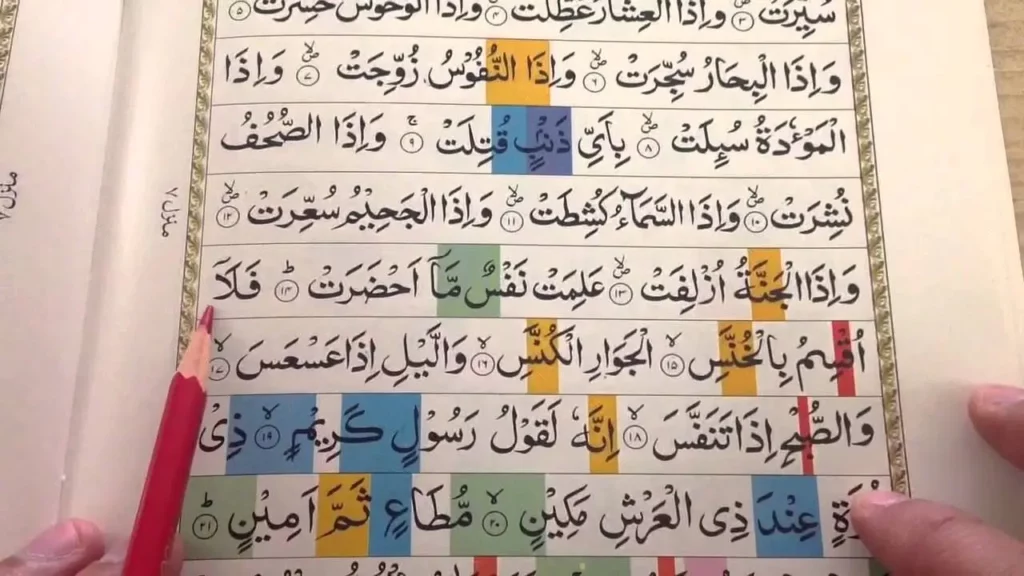
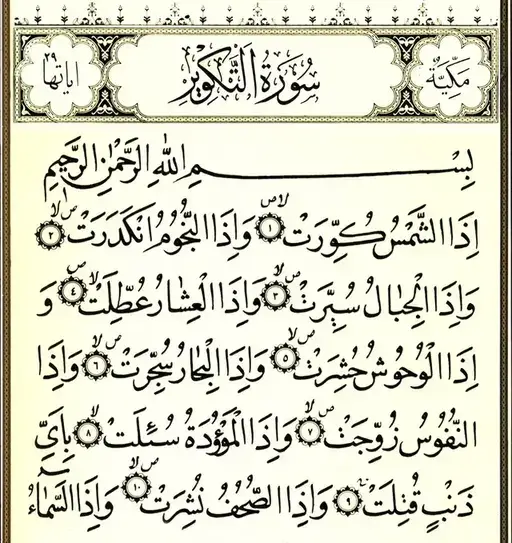
سورة التكوير باللغة العربية
بِسْمِ اللَّهِ الرَّحْمَانِ الرَّحِيمِ
1. إِذَا الشَّمْسُ كُورَتْ
2. وَإِذَا النُّجُومُ انْكَدَرَتْ
3. وَإِذَا الْجِبَالُ سُيِّرَتْ
4. وَإِذَا الْعِشَارُ عُطِّلتْ
5. وَإِذَا الْوُحُوشُ حُشِرَتْ
6. وَإِذَا الْبِحَارُجِّرَتْ
7. وَإِذَا النُّفُوسُ زُوِّجَتْ
8. وَإِذَا سُمَوْءُودَةُ سُئِلَتْ
9. بِأَيِّ ذَنْبٍ قُتِلَتْ
10. وَإِذَا الصُّحُفُ نُشِرَتْ
11. وَإِذَا السَّماءُ كُشِطَتْ
12. وَإِذَا الْجَحِيمُ سُعِّرَتْ
13. وَإِذَا الْجَنَّةُ أُزْلِفَتْ
14. عَلِمَتْ نَفْسٌ مَا أَحْضَرَتْ
15. فَلَا أُقْسِمُ بِالْخُنَّسِ
16. الْجَوَارِ الْكُنَّسِ
17. وَاللَّيْلِ إِذَا عَسْعَسَ
18. وَالصُّبْحِ إِذَا تَنَفَّسَ
19. إِنَّهُ لَقَوْلُ رَسُولٍ كَرِيمٍ
20.قُوَّةٍ عِنْدَي الْعَرْشِ مَكِينٍ
21. مُطَاعٍ ثَمَّ أَمِينٍ
22. وَمَا صَاحِبُكُمْ بِمَجْنُونٍ
23. وَلَقَدْ رَآهُ بِالْأُفُقِ الْمُبِينِ
24. وَمَا هُوَ عَلَى الْغَيْبِ بِضَنِينٍ
25. وَمَا هُوَ بِقَوْلِ شَيْطَانٍ رَجِيمٍ
26. فَأَيْنَ تَذْهَبُونَ
27. إِنْ هُوَ إِلَّا ذِكْرٌ لِلْعَالَمِينَ
28. لِمَنْ شَاءَ مِنْكُمْ أَنْ يَسْتَقِيمَ
29. وَمَا تَشَاءُونَ إِلَّا أَنْ يَشَاء اللَّهُ رَبُّ الْعَالَمِينَ
Memorizing Surah At-Takwir
Memorizing Surah At-Takwir is not difficult, but you should follow a strategy for memorizing and teaching it to your children as follows:
1- At Home
Read Surah At-Takwir and memorize it in sections, reviewing what you have memorized before moving on to the next section.
Practice makes perfect. Record what you have memorized and listen to Surah At-Takwir four times a day.
Listen to Surah At-Takwir recited by a reciter you admire and who enjoys reciting Surah At-Takwir.
Ask your family to participate in memorizing Surah At-Takwir with you.
Choose the section you want to memorize and recite it during the five daily prayers to make it easier for you to repeat and memorize.
2- At the Mosque
You must know the rules of Tajweed and the correct pronunciation of the verses of Surah At-Takwir. This will facilitate memorization and correct recitation without errors.
Participate in memorization circles at the mosque, as well as circles for remembrance and interpretation.
Reading and memorizing the Quran after Fajr prayer is one of the best times to increase concentration and memorization. The process of memorizing the surahs relied on a single copy of the Holy Quran and focused on utilizing visual memory, a highly effective strategy for improving memorization and learning skills.
3- On Online Platforms
Participate in group memorization sessions via social media platforms, which foster a spirit of competition, such as WhatsApp, Telegram, and Facebook.
Listen to the best reciters on YouTube and leave your feedback.
Write down what you have memorized to reinforce your learning.
You can use the Hader method for excellent review.
Review what you memorized yesterday before starting new sections.
Would you like your children to learn more about online Quran lessons? Enroll in the “Quran Oasis” online Quran lessons program and watch them delve into the sciences of the Holy Quran and learn the Book of Allah.
Quran Oasis offers online Arabic language lessons for children and Quran lessons for adults. Let your children learn to recite the Holy Quran accurately and pronounce words correctly, even if Arabic is not their first language.
Teaching the Holy Quran to children at Oasis of the Holy Quran is enjoyable and structured, and they will learn with the Holy Quran e-learning program.
A Quran teacher, an Arabic language teacher, an Islamic studies teacher, and a Tajweed teacher (Bayt Al-Quran) will be their companions throughout this wonderful journey.
Learning the Holy Quran online can be challenging if you’re looking for it for your children. Oasis of the Holy Quran offers a variety of topics for teaching your children online.
Oasis of the Holy Quran has two experienced teachers (two male teachers and one female teacher). They have extensive experience teaching Arabic and the Holy Quran online to non-native speakers.
Whether you’re looking for online Quran, Arabic language, Tajweed, Ijazah (certification), Tafsir (exegesis), Qira’at (recitations), Quranic recitation rules, or Islamic studies, Oasis of the Holy Quran provides support through professional Quran teachers ready to guide your children’s education. With an attractive interface and well-organized lessons,
The Quran Oasis offers you and your children the opportunity to learn with verses from the Holy Quran, which will become your children’s new friends, accompanying them on their learning journey and encouraging them to learn more.
The Quran Oasis (Online Quran Institute) is the best online Quran classroom.
Summary of Surah At-Takwir
Surah At-Takwir is derived from the first verse:
(When it is folded up) meaning: when the earth is folded up.
It was revealed in Mecca, most likely in the early days of the Prophet Muhammad’s (peace be upon him) mission.
The main message of Surah At-Takwir is the Hereafter and the establishment of prophethood.
Surah At-Takwir narrates the end of the world in a very compelling way, conveying some scenes of the Day of Judgment, when all creatures, the forces of nature, and human capabilities will perish.
Surah At-Takwir summarizes all these meanings as follows:
● Verses 1-14: The terrifying signs of the Day of Judgment.
● Verses 15-25: An oath that the Quran is the word of God, and that Muhammad is neither insane nor a deluded devil.
● Verses 26-29: The Holy Quran is a reminder to humanity.



Pingback: Why Do Muslims Wear Hijabs? | Quran Oasis