
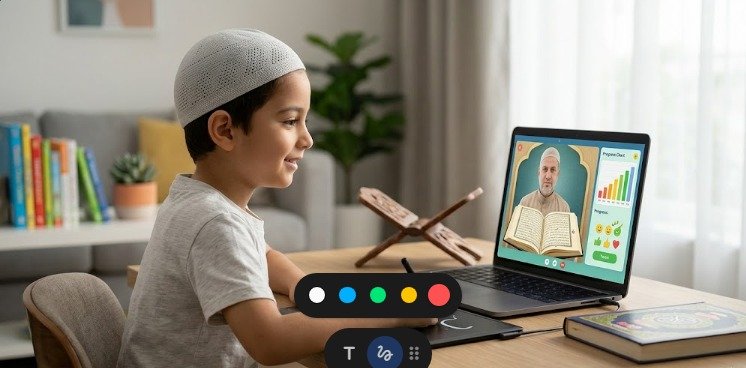
online Quran classes for kids A few years ago, the idea of a child sitting at home and learning the Quran through a screen — with a qualified teacher thousands of miles away — would have seemed like a significant compromise. Today, for millions of Muslim families across the UK, USA, Canada, and Australia, it has become the most practical, effective, and spiritually fulfilling option available.
But convenience alone does not explain why families keep choosing online Quran education year after year. The real reasons run deeper. Parents who have watched their children progress through an online program consistently describe benefits they did not expect when they first signed up — changes in their child’s confidence, focus, relationship with prayer, and sense of Islamic identity.

If you are weighing up whether online Quran learning is right for your family, this article is for you. Here are ten genuine benefits — grounded in the experience of real students and families, not marketing copy.
See the difference for yourself. Book a completely free trial class for your child at Quran Oasis — no payment, no commitment. Claim your free trial here →
10 Benefits of Learning Quran Online for Children
1. Access to Truly Qualified Teachers — Regardless of Where You Live
This is perhaps the most significant benefit, and it is one that parents in smaller cities and towns feel most acutely. In many parts of the Western world, finding a local Quran teacher who holds a formal qualification — let alone an ijazah from a recognized institution — is genuinely difficult. Families either settle for whoever is available locally, or they drive long distances to reach a better option.
Online learning removes that limitation entirely. At Quran Oasis, every teacher has graduated from Al-Azhar University in Egypt — the world’s oldest and most respected Islamic institution. Your child in a small town in Scotland has access to the same quality of teacher as a family living near a major Islamic center in London or Chicago. That equality of access is something the previous generation of Muslim parents simply did not have.
2. One-on-One Attention That Group Classes Cannot Match
In a traditional group madrasa setting, a teacher might be managing twelve to twenty students simultaneously. Inevitably, children who are shy, slower to progress, or easily distracted do not get the individual attention they need. They fall behind quietly, and no one notices until the gap has become significant.
Online Quran classes at Quran Oasis are entirely one-on-one. The teacher’s complete focus is on your child for every minute of every session. Mistakes are caught and corrected immediately. Strengths are recognized and built upon. A child who struggles with a specific tajweed rule does not get left behind because the class is moving on — the teacher stays with them until it clicks.
3. Flexible Scheduling That Fits Real Family Life
Muslim families in the West navigate a lot: school schedules, after-school activities, work shifts, time zones that do not align with the Muslim world, and weekends that are already packed. Fitting a consistent Quran education into that reality used to mean real sacrifice.
With online classes available 24 hours a day, seven days a week, that sacrifice is no longer necessary. Morning before school. Evening after homework. Saturday at 9 AM. Sunday after Fajr. You choose the time that works for your family, and it stays yours. Quran education becomes something that fits into your life rather than competing with it.
4. A Comfortable Learning Environment Reduces Anxiety
For many children — particularly those who are naturally shy or who have had negative experiences in group learning settings — the home environment makes a profound difference. There is no pressure of performing in front of peers. There is no fear of being laughed at when a pronunciation is wrong. There is just the child, the teacher, and the lesson.
Parents consistently report that children who were reluctant to attend physical classes become genuinely engaged when learning from home. The psychological safety of a familiar environment, combined with a patient one-on-one teacher, removes the social anxiety that can otherwise become a significant barrier to progress.
5. Consistent Progress Tracking
One of the frustrations many parents experience with informal Quran education is not knowing where their child actually stands. Is the teacher covering material at the right pace? Is the tajweed correct? Has anything been missed?
A structured online program answers these questions clearly. At Quran Oasis, teachers provide regular feedback on student progress, parents can monitor their child’s development, and lesson plans are designed to ensure nothing important is overlooked. There is a clear path from complete beginner to confident, correct recitation — and you can see exactly where your child is on that path at any given time.
Online Quran Classes for Youth & Young Adults
Our teachers at Quran Oasis build personalized lesson plans for every student — from first-time beginners to children preparing for hifz. Explore our courses for children →
6. Proper Tajweed From Day One
Tajweed — the set of rules governing the correct pronunciation and recitation of the Quran — is not an advanced topic. It is foundational. Errors in tajweed learned early become deeply embedded and are notoriously difficult to correct later. This is one of the strongest arguments for qualified instruction from the very beginning of a child’s Quran education.
At Quran Oasis, tajweed is integrated into every level of the curriculum, not treated as a separate subject to be introduced later. A child in our Reading Quran Basics course is learning correct pronunciation from their very first lesson — building clean habits that will serve them for the rest of their lives.
7. Stronger Connection to Islamic Identity
This benefit is harder to quantify but deeply felt by parents who observe it. Children who learn the Quran with a qualified teacher who genuinely loves what they are teaching absorb more than just the text. They absorb a sense of reverence for it. They begin to understand that the words they are learning carry centuries of careful, loving preservation behind them.
That awareness — that this is something sacred and serious, passed from teacher to student in an unbroken chain — gives children a sense of belonging to something much larger than themselves. In a world that offers Muslim children in the West many competing identities, that rootedness matters enormously.
8. No Commute, No Coordination, No Cancellations
The practical friction of getting a child to a physical class consistently — especially in winter, especially after a long school day, especially when a sibling has a conflicting activity — is not trivial. It is exactly the kind of friction that turns a well-intentioned routine into a sporadic one.
Online classes eliminate that friction completely. There is no journey. If a class needs to be rescheduled due to illness or an unexpected commitment, it is handled with a quick message, not a missed session that cannot be recovered. That consistency — class after class, week after week — is what produces genuine long-term progress.
9. Siblings Can Learn Together or Separately — Your Choice
Families with multiple children often find that their kids are at different levels and progress at different rates. In a group class, that creates problems. Online, it is simply handled. Each child has their own scheduled sessions with a teacher suited to their level and personality. There is no pressure on faster learners to slow down, and no pressure on those who need more time to rush.
Some families also choose to have siblings share a session when they are at similar levels — it introduces a gentle element of accountability and shared experience without the downsides of a large group.
10. It Builds a Habit of Lifelong Learning
Perhaps the most lasting benefit of consistent online Quran education is what it teaches a child about learning itself. A child who sits down three times a week, engages fully with a teacher, works through difficulty patiently, and watches their own progress accumulate over months and years is developing something far beyond Quran knowledge. They are developing discipline, patience, and the understanding that mastery comes through consistent effort — not shortcuts.
These are qualities that will serve them in every subject at school, in every skill they attempt in life, and in their relationship with Allah long after their formal Quran education has ended.
What Makes a Good Online Quran Program for Children?
Not every platform that offers online Quran classes delivers on these benefits equally. Here is a quick checklist for parents evaluating their options:
- Certified teachers with verifiable qualifications — not just “experienced tutors”
- One-on-one format rather than group sessions, especially for younger children
- Free trial class before any financial commitment
- Flexible scheduling with classes available across time zones
- Female teachers available for families who prefer gender matching
- Tajweed integrated from the beginning, not added later as an optional extra
- Clear progress structure so you know where your child is at all times
Quran Oasis meets every one of these criteria. Our program was built specifically for Muslim families in the West who want the quality of a traditional Al-Azhar education delivered in a format that works within their actual lives.
Frequently Asked Questions
Is online Quran learning as effective as in-person classes?
For most children, yes — and for some, it is more effective. The one-on-one format means more focused attention than a typical group class. The home environment reduces social anxiety. And the flexible scheduling makes consistency far easier to maintain. The key variable is teacher quality, which is why certified credentials matter so much.
How long before my child shows real progress?
Most children attending three sessions per week show noticeable improvement in Arabic letter recognition and basic reading within four to six weeks. Tajweed refinement and fluent reading typically develop over several months of consistent study. Progress varies by age and prior exposure, but every child who attends regularly moves forward.
What if my child misses a class?
Life happens. Missed sessions can be rescheduled based on teacher availability. Consistent attendance produces the best results, but occasional disruptions do not derail a well-structured program.
Do parents need to be involved in the classes?
For younger children (under 7), we recommend a parent be nearby — not necessarily in the room, but available. For older children, classes run independently. Some parents choose to sit in occasionally to stay informed about what their child is learning, which we always welcome.
A Gift That Lasts a Lifetime
The Quran is not just a subject. It is a companion for life — in prayer, in difficulty, in gratitude, and in the quiet moments when a person needs something steadier than the world around them. Giving your child a relationship with it, grounded in correct recitation and genuine understanding, is one of the most enduring investments a parent can make.
Online learning has made that investment more accessible than at any point in history. The barriers of geography, scheduling, and access to qualified teachers that limited previous generations of Muslim families no longer apply. What remains is simply the decision to begin.
Book your child’s free trial class at Quran Oasis today. Your first session costs nothing. What your child gains from it — that is priceless.
Give Your Child the Gift of the Quran
Certified Al-Azhar teachers. One-on-one classes. Available 24/7. First class completely free.
Related Articles:
- Online Quran Classes for Kids: A Parent’s Complete Guide
- How to Memorize the Quran: 10 Proven Tips That Actually Work
- Tips for Memorizing Quran for Busy Professionals

